10 Ways To Use Fidget Spinners in Your Classroom

Fidget spinners. Again another post about fidget spinners. You're correct. The new pattern is somewhat overpowering and it gets exhausting to dependably read similar things. 


This post doesn't talk about whether fidget spinners ought to be restricted in schools or not. This post demonstrates to you the conceivable outcomes of wriggle spinners as a learning material. 

As Pokémon Go urged youngsters to go strolling and bicycling once more, squirm spinners attempt to expand an understudy's level of consideration. A few instructors despise it, some adoration it. In any case, that is not the point. Pokémon Go manufactured the extension to expanded reality in the classrooms, Fidgets spinners will do likewise with toys. 

It may appear to be insane, however it's best to give it a shot yourself. Here are some fun classroom exercises you can do with fidget spinners.


Fun classroom activities with fidget spinners


1. Teaching math with fidget spinners

Multiplication tables

Draw a circle on a paper and divide it into 10 (pizza) parts. In those different parts you write random numbers from one to ten. Place a little dot or arrow on one end of the fidget spinner. Best is to do this exercise in groups of two. Now, students have to put the fidget spinner in the middle of the circle on their paper and give it a spin. Another student shouts out a number from one to ten. When the spinner stops spinning, students have to multiply the number of the first student with the number on their paper, chosen by the fidget spinner.

Additions and subtractions

This exercise kind of works the same as the one above, but students can do this individually. Draw a circle, divide it into parts, and write down different numbers. Make sure to use small numbers for easy exercises and big numbers for more complicated exercises. Students give the fidget spinner a spin. When it stops spinning, students have to add or subtract the three chosen numbers (by every end of the fidget spinner) with each other. Let them write down their calculations on paper.

Arithmatic

To encourage students to make quick calculations without a calculator you could give them a challenge. “How many calculations can you make in the time of one spin?” Let your students spinn the wheel and solve as many calculations on their worksheet as they can. Then ask them “How many spinns did you need to finish the complete exercise?”. Off course, you can’t just focus on time. The calculations have to be correct too.

Stats and graphs

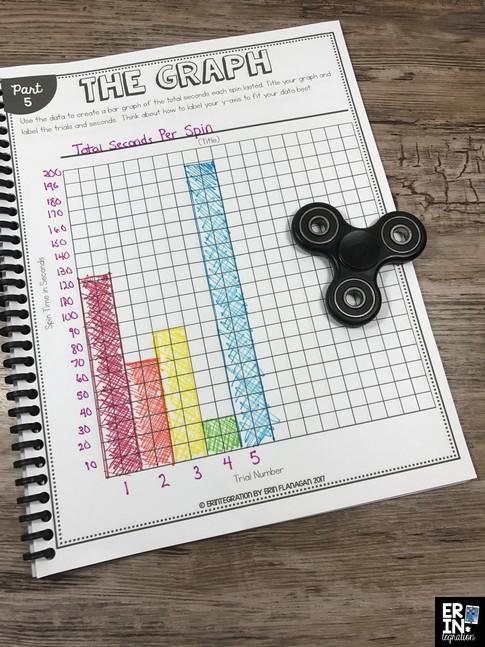
Teach your students to draw and analyze graphs. Let them spin their fidget spinner 10 times. Each time they have to write down how long the spinner kept spinning and if they had made a human mistake or not. Afterwards, they have to make a graph out of it. This way it’s more visual and clear. Now ask them if they can link the human mistakes to the time of their spins.

2. Teaching languages with fidgets spinners

Speaking

Let your students pair up. Each group has a fidget spinner. One student gives the spinner a spin and the other has to introduce himself or talk about a certain topic for as long as it keeps spinning.

Vocabulary

Just like with math exercises, you can make a circle with new words in it. Let your students spin the spinner on the card. Let them explain the word, translate it, give a synonym, use it in a sentence, etc.

Reading

To define a students reading level they often have to read a list of words as fast a possible. Let your students practice for that test with a fidget spinner. How many words can they read in one spinn?

3. Teaching physical exercises with fidget spinners

Work out

Let your students do one exercise during the complete time the fidget spinner is spinning. Then, go on to the next one. Let your students choose the exercise and spin the spinner one by one. Some exercises will be brief, others not.

Balance estafette

Divide your students into 4 or 5 groups. Each of them gets one fidget spinner. The first student of each group puts the fidget spinner on its forehead while spinning and tries to reach another student without losing it. Which group is the fastest?

Fidget yoga

Fidget spinners are made to keep students' attention and focus. So why not do yoga with it? Practice some standard and harder positions, then ask your students to place the fidget spinner somewhere on their body, while doing the exercises. Will it fall or not? Focus!


How to Put a Fun and Educational on Fidget Spinners

How to Put a Fun and Educational on Fidget Spinners

It didn't take ache for fidget spinners to wind up noticeably the most recent play area fever, and it didn't take ache for schools to start forbidding the hot new toy. Fidget spinners were initially intended to expand fixation and center and diminish tension for understudies who have ADHD and Autism. Notwithstanding, once understudies began bringing these small turning contraptions into the classroom, kids wherever needed one or the greatest number of as they could discover. 

So while these gadgets were helping numerous understudies, regularly educators and overseers discovered they were having the inverse impact for a few understudies. Be that as it may, if your children cherish fidget spinners and you have a couple skimming around your home, here are simple instructive exercises to put a positive turn on fidget spinners.
DIY Fidget Spinner
Red Ted Art
If your kids keep asking for more fidget spinners, why not try this activity and create a DIY fidget spinner. Your kids will use supplies you already have at home, and then they can compare which materials worked best.
fidget spinner graph
Erintegration
Fidget Spinners seem so simple, but your kids can actually create some pretty impressive STEM charts and graphs based on a little fidget spinner science. This fidget spinner STEM project is perfect for a rainy day and a little spinning.
Turn your fidget spinner into a powerful tool for teaching letters, sounds, words, and numbers. As your kids give the fidget spinner a few quick spins, let them see how many of their letters and sounds they can recite back to you before the spinner stops.

Make this activity even more hands on by giving your kids a bingo dot marker as they race against the fidget spinner.
pre-school packets
preschoolpowolpackets

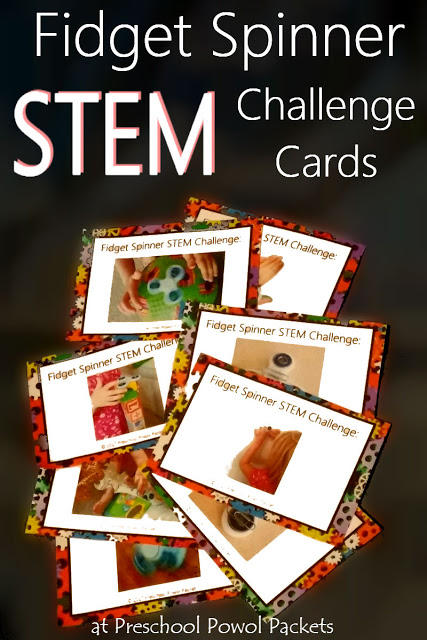
Preschoolers are naturally curious and you can use fidget spinners to tap into that curiosity. Using challenge cards, your preschooler can use the fidget spinner to explore and experiment all over your home.
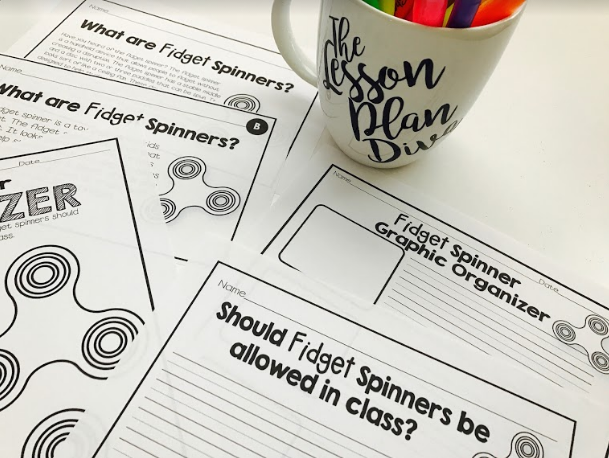
Are fidget spinner banned in your child's school? Put their persuasive writing skills to test with this activity. Have your kids build an argument as to why these toys are so useful. They can speak their mind and sharpen up their writing skills.
Fidget Spinner LP
Lesson Plan Diva


We Should Discuss Fidget Spinners and Examples.

We Should Discuss Fidget Spinners and Examples.

Fidget spinners are a craze. Thinkpieces about fidget spinners, in this manner, are additionally a craze. That is how it functions, isn't that so? On one side, there's kin who are contending that these are toys (genuine), that they are a prevailing fashion (genuine), that they can occupy a few people (genuine), that there is not explore demonstrating enhanced concentration from their utilization (genuine), and that they are not an openness issue (false). On another side, there's kin contending that they are a concentration device for some mentally unbalanced individuals as well as individuals with AD(H)D (genuine), that the absence of proof is because of an absence of research and not an announcement of inefficacy to use against people who discover them helpful (genuine), this can be an availability issue (genuine), and that their prevailing fashion nature among neurotypical understudies is terrible (false) in light of the fact that it is getting the toys restricted (blended truth esteem). I've additionally observed more nuanced sees, by and large from handicapped individuals, however those appear to be the two primary camps.

I want to point out a pattern in how accessibility discussions go, especially in educational contexts.

  1. A disabled person needs something for access reasons.
  2. Abled people call the thing distracting, because our existence in public is apparently distracting.
  3. The thing is either banned entirely or permitted only for people with the paperwork to prove they need it for disability reasons.
  4. Disabled people who need the thing either don't have access to the thing or must out themselves as disabled in order to gain access. If outing oneself is required, the thing is heavily stigmatized.
  5. Disabled people who have an actual access conflict with the thing are erased entirely, which makes conversations about possible solutions to the access conflict impossible. One set of needs or the other will "win." Any disabled people who need to avoid the thing are lumped in with the people who want to ban the thing for ableist reasons and therefore vilified. Which set of needs "wins" here varies, but it usually has some relationship to hierarchy of disability stuff and having one set "win" while the other "loses" is a bad solution regardless.


That's not just a fidget spinner thing, but it does apply here. With fidget spinners, autistic people and folks with ADHD (I'd love to know of a reasonably recognized way of talking about this neurotype without the second D/in a neurodiversity paradigm way, btw) end up in both the "need the thing" and the "need to avoid the thing" groups. I assume some other neurotypes are similarly split as well - I just don't have the familiarity to assert so. With visual alerts on fire alarms, D/deaf people need the thing. Since the visual is a strobe, a lot of neurodivergent people, especially people with photosensitive epilepsy, need to avoid the thing. With service animals, the folks who use them need the thing. People with allergies need to avoid the thing, and not everyone with an allergy can safely share a space with a service animal, even if they are treating their allergies. Conflicting access needs exist, and this pattern prevents us from finding ways to deal with the conflicts. Instead, one access need gets lumped in with abled people who don't like the thing because it's associated with disability and therefore presumed not to be a real need.

Now for fidgets: some people need something to do with their hands while listening if they're going to retain anything. I am in this group, by the way. In high school, I knit, I sewed, and I made chainmail - armor, not spam. I've also tried drawing, which takes care of the "need to do something in order to sit" issue but takes enough attention that I'm no longer following the conversation, so that doesn't work for me in class. Writing hurts quickly enough that while taking notes has sometimes been possible at university, there was no way it was going to be the answer for the duration of a school day in middle or high school. (I, specifically, should not have a laptop in class. If I'm going to need notes it's the least bad option, but least bad does not mean good.) So I did assorted arts and crafts that were fairly repetitive and totally unrelated to class. The biology teacher who told us on day one that he had ADHD was both the most understanding teacher about my need to fidget somehow and the teacher most at risk of being distracted by my making armor in class.

That last paragraph is the "no, really, I need to fidget." It's also the "there are several fidget options that work for me." Most, but not all, of the standard fidget toys will meet my needs, as I discovered because they are also a fad and I got some awesome fidget toys. This is important, when access conflicts come into play - if there are several options that meet the access need of the first disabled person, it's easier to find one option that everyone is OK with. When there are several options that work, requesting "not option A in situation W" is not an access issue, because options B through H are still fine. If we're going to come up with reasons that each of B through H are also not fine, individually, then we're going to have a problem.

The fidget toy fad is making options D through H cheaper and cooler. When fidgets are marketed as assistive technology, they are super expensive. Considering that disabled people tend not to have a lot of money, that's an access issue, so the fad is making a set of possible solutions more accessible. That's cool. It's also leading to a sufficient presence for teachers to make explicit policies about the toys (as opposed to banning them person by person), and for a flat ban to seem like a good idea to teachers who are seeing kids appear distracted by them. (My bet is that the neurotypical students who appear distracted actually are. I expect the autistic and ADHD students who appear distracted are a mix of actually distracted because they are just as distractable as any other student and only appearing to be distracted because of ableist ideas about what paying attention looks like. Remember, I'd fail special needs kindergarten as a twenty-four year old PhD student.) The explicit banning for everyone is ... not so good. Mostly because the other options are usually also disallowed or heavily stigmatized, and then we may well be left with no good options.

And let's not pretend handing everyone a fidget spinner, or any other fidget, is going to magically "solve ADHD" or whatever. I think some of the camp that's firmly against the toys is reaching that position for similar reasons to haters of weighted vests - we hand it over and the person is still autistic, or still ADHD. A tool that a person uses to cope in a less than accessible environment doesn't make them stop being disabled by the environment. Plus a fidget spinner isn't going to help everyone. Some people really will be distracted if they have something to play with, and some of those people really will be neurodivergent. Conflicting access needs, again, are a thing. If one person needs a fidget, and another needs not to be next to someone with an obvious fidget, those two people probably shouldn't sit next to each other. Giving people fidgets that they can use while the toy remains in their pocket is also a possibility in some cases. We can have conversations about access conflicts, if we admit that both sets of needs exist. (We also need to admit that some subset of the people making arguments about distraction are doing the bad faith argument where everything disabled people need is a distraction because, essentially, our presence in public is a distraction.)
The Sources of the Fidget Spinner...

The Sources of the Fidget Spinner...

so it turns out those fidgw spinners that can be so irritating, yet perhaps accommodating to kids who require help concentrating on things, was made by a Jewish lady who thought of this as an approach to get Palestinian children to quit tossing rocks at Israeli police. Cap Tip to Aussie Dave of IsreallyCool..


http://amzn.to/2tPEYHI


Catherine Hettinger has an inventor's mind: When she notices a problem, she tries to imagine a toy or device that can remedy it.
So when she heard about young boys throwing rocks at police officers and people walking past them while visiting her sister in Israel, her wheels started turning. She started brainstorming devices that could distract young children and provide them with a soothing toy to play with.
First, she thought of a soft rock that kids could throw. But then she tossed that idea aside, still thinking about other options when she returned to her home in Orlando, Fla. It was there that she eventually developed the idea that would become the original fidget spinner — more than two decades before the wildly popular device became the must-have toy for both kids and adults this year.
“It started as a way of promoting peace, and then I went on to find something that was very calming,” Hettinger, now in her 60s, told MONEY of the fidget spinners, which she first began imagining back in the 1980s.


it took a lot of time until it went to market and became the hit it became , but these are the origins...


Should the Work Environment Toy Around with Fidget Spinners?

Should the Workplace Toy Around with The wriggle spinner. Each child either has one, or needs one. Presently the inquiry is: should the work environment toy around with them, as well? 

My review schooler has been requesting one of these vivid spinny things (my words) for a considerable length of time. Everybody at school has one! I at long last collapsed and requested one for under £10 in Amazon . It is relied upon to touch base via the post office on the most recent day of school. Go figure.


If you haven't heard of the fidget spinner, it's a small, three-pronged piece of plastic that -- you guessed it! -- spins around very quickly. Fidget spinners come in different shapes and colors, and some models even glow in the dark. They fit in our hands, and capture our attention. The fidget spinner is marketed as being a stress-relieving device for children with ADHD, ADD, anxiety or autism. They inhabit a toy category called "fidget toys."


Schools have been banning them, experts are debating them, and the Fidget Spinner Association wants everyone to enjoy them.


But what about the workplace, where we need to stop fiddling around and get back to work? Managers who haven't encountered fidget spinners in the open office environment may see them soon enough. If you're a manager who wants to create a "fun" (read: less stressful) workplace culture, then fidget spinners might put a new spin (pun intended) on things. The downside to using fidget spinners in the workplace? Well, a co-worker might give us the annoyed side eye and ask: "Could you put that away? It's distracting." One employee's attempt to de-stress could become another employee's distraction. We'll see how the average manager plays it. 

My opinion? If a fidget spinner helps you focus and/or lowers your anxiety levels, then go for it. Just be courteous toward those around you when you sit and spin. 

You might also check out a new fidget spinner app that is the number-one download on the App Store today. This way, you can play on your phone while your colleagues think you're checking your messages. We'll see whether or not the fidget spinner takes off in the workplace. In the meantime, I'll let you focus on your work.